Sinking & Settling Foundation Repair in Greater Richmond
We can solve structural problems caused by foundation settlement in Virginia

Foundation settlement and house movement can occur when a soil layer can't support the weight of the home.
Have you noticed cracks in your foundation walls, uneven floors, or sticking windows in your home? If these sound like problems you've experienced, you may have a sinking or settling foundation.
At The Drying Company, we fix foundation settlement issues by installing steel foundation piers. These piers will extend beneath the foundation, contacting strong supporting soils that will permanently stabilize your structure.
The Drying Company are your local experts for all types of foundation repair. Call us for a free foundation inspection and foundation settlement repair quote today! We serve Virginia Beach, Richmond, Henrico and many nearby areas in Virginia.
Identifying foundation settlement issues
Signs of a settling foundation can be very subtle at first -- many homeowners can go months or even years before noticing a crack in their foundation. The long-term damage from foundation settlement, however, is ongoing and will lead to more severe foundation problems.
5 Signs of Foundation Settlement
Stair-Step Cracking
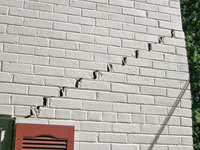
Stair-step cracking is very common in brick and concrete block walls and is a sure sign of foundation settlement. As the settlement house movement continues, vertical cracks may widen or become uneven as wall sections tilt away from each other, indicating more severe displacement.
Keep an eye out for cracks that are wider at the top than at the bottom, as this is a sign of advancing settlement.
Tilting Chimneys
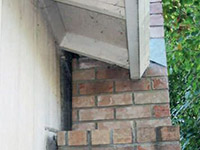
Tilting chimneys that are separating from the home are one of the most intimidating and dramatic signs of a settling foundation.
Sometimes a chimney is built on a footing that is not connected to the house foundation. In this situation, the enormous weight of a chimney can make it even more at risk of settlement.
Damaged Doors & Windows
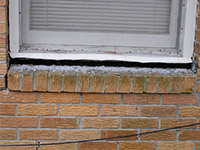
An opening cut in any wall is a weak point, so signs of foundation settlement and house movement often show up around door and window openings.
Doors and windows frames may be racked out of square, cracks may extend from the corners above doors and windows, and doors may separate from the framing or exterior finish. Other signs of foundation settlement include sticking or jamming doors and windows, and locks that stop working.
Slab Floor Cracking
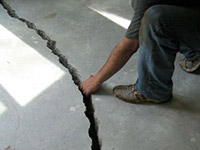
Cracks in your concrete floor slab can be a sign of foundation settlement, but they may also be a sign that the slab floor alone has settled.
There are times when your slab floor may sink or lift independently of the foundation walls, damaging the floors but not necessarily the foundation walls themselves.
Drywall Cracks
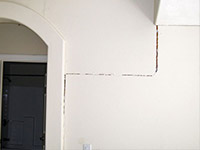
Cracks in drywall throughout the house are reliable indicators of foundation settlement. Cracks will often be larger and more obvious in the home's upper levels.
Typical drywall cracks during foundation settlement are commonly located at the corners of doors and windows and along drywall seams. Drywall tape can also be a good indicator, especially if it's ripping or coming loose. Drywall cracks can also be a sign of sinking crawl space supports, sinking floors, and heaving floors.
Repairing foundation settlement
At The Drying Company, we recommend installing foundation piers to stabilize, repair, and restore a foundation that's been damaged by issues related to foundation settlement and poor supporting soils.
There are several different types of foundation piers that are designed to address each kind of foundation problem. We install three different kinds of foundation piers: push piers and helical piers.
Foundation Push Piers
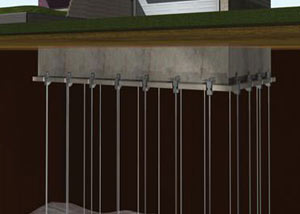
Push piers connect the foundation to strong, stable soil or bedrock. Foundation piers attach to the base of the foundation with special brackets and extend through settling and unstable soil layers, transferring the weight of your home to competent soils.
Foundation push piers are straight, steel piers that attach to your foundation and extend far below the structure to strong supporting soils. During the installation, a section of the foundation footing is exposed and cut to attach to each pier's bracket. This is possible year-round from either inside or outside of your foundation or structure.
Foundation brackets are secured to the footing, and tubular pier sections are hydraulically driven through each bracket. Pier sections continue to be driven downwards until the piers meet competent strata that can bear the weight of your home without compression.
When all push piers have been installed, they will work in unison to transfer the weight of the structure to the strong soils or bedrock below. If possible, the home is also lifted back to its original, level position.
More about installing foundation push piers.
Foundation Helical Piers
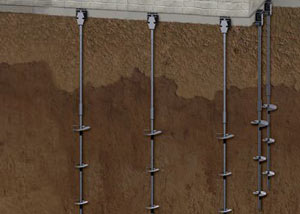
Like push piers, helical piers are attached to the foundation by mounting a bracket. Helical piers include rotating blades that are advanced (or "screwed") into the soil.
Foundation helical piers are straight, steel piers that have helical blades welded to each shaft. This installation is possible from either inside or outside of your foundation. These piers are driven into the soils underneath your foundation, then each pier is connected to the structure's foundation via a steel bracket.
During the installation, a section of the footing is exposed and cut for each bracket. Next, round-shaft helical piers are mechanically advanced into the soil. Once the helical pier has been advanced into the soil, a foundation bracket is secured to the footing.
When all helical piers have been installed, they will work in unison to transfer the weight of the structure to competent soil. If possible, the structure is also lifted back to a level position.
More about installing foundation helical piers.
We repair settling foundations in VA!
At The Drying Company, we can identify and repair any issue you may be having with settling, sinking foundations, and settlement house movement. We have a wide variety of solutions for foundation repair that have been tested and proven effective throughout the United States and Canada through the Supportworks network of foundation contractors.
Each of our solutions starts with a free, written foundation repair quote, and includes a personal consultation with a foundation expert, an in-person inspection, and a free copy of our 90-page foundation repair book. To schedule an appointment with one of our specialists, call or e-mail us today! We proudly serve Virginia Beach, Richmond, Henrico, Williamsburg, Midlothian, Newport News, Chesapeake, Norfolk, Chesterfield, Hampton, and nearby.
Looking for a price? Get a no cost, no obligation free estimate.
Our Service Area

our service area
We serve the following areas
- Ashland
- Aylett
- Beaverdam
- Bowling Green
- Bruington
- Callao
- Caret
- Champlain
- Coles Point
- Colonial Beach
- Corbin
- Dahlgren
- Dogue
- Doswell
- Dunnsville
- Fredericksburg
- Hadensville
- Hague
- Hanover
- Haynesville
- Hustle
- Jersey
- King George
- Kinsale
- Ladysmith
- Loretto
- Lottsburg
- Milford
- Montpelier
- Montross
- Mount Holly
- Newtown
- Ninde
- Oldhams
- Partlow
- Port Royal
- Rappahannock Academy
- Rockville
- Rollins Fork
- Ruther Glen
- Saint Stephens Church
- Sandy Hook
- Sandy Point
- Sparta
- Stratford
- Tappahannock
- Thornburg
- Warsaw
- Woodford
- Zacata


