Why Are Some Rooms Hotter Than Others in My House?
Have you been battling one room in your house that is way too hot during warmer months? You might be using fans to try to make it bearable, or just closing the room off completely to keep it from affecting the rest of the house.
You’re not alone. A lot of Virginia families throughout Ivor, Dutton, and King George experience the same problem.
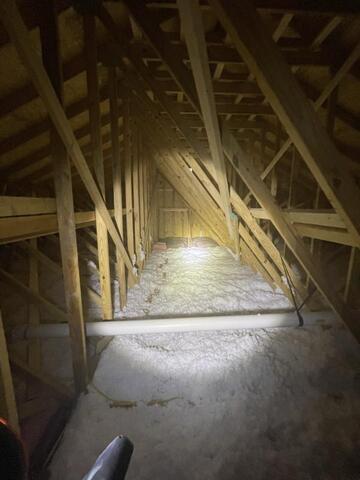
Before: Attic with minimal insulation.
What Causes the Room to Be Too Hot?
Often, the rooms that are too hot and uncomfortable to use are directly below your home’s attic. The heat from your attic is what’s making the rooms below uncomfortable.
Let’s look at what’s happening:
- The sun heats up the roof.
- The roof heats up the attic. (Radiation)
- The attic heats up the ceiling of the rooms below. (Conduction)
- That heat transfers to the room you can’t seem to cool down. (Radiation)
How much heat transfers into your home depends heavily on the amount and quality of insulation in your attic. That insulation determines how much resistance to heat there is between the roof and the attic, and between the attic and the rooms below it.
Other Signs Your Attic Might Be the Problem
An uncomfortable room is a good indicator that there’s a problem with the insulation in your attic. It’s not the only clue you have to insufficient insulation, though.
You might also notice:
- Excess heat around your attic access, such as a scuttle or pull-down stairs
- High energy bills
- Frequently running HVAC
- Dust or dirt around air registers
- Air never seems to come out of your vents cold, especially if your ducts are in the attic
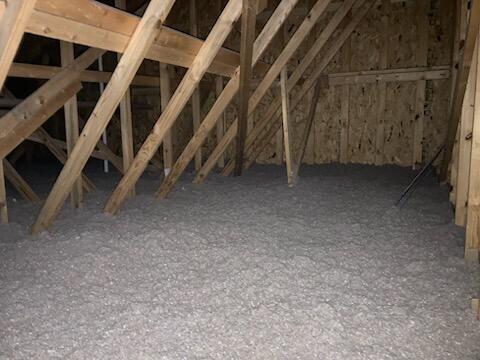
After: Blown-in cellulose insulation
Quantity and Quality of Insulation Matter
You might be thinking:
“But wait, my attic has insulation, that’s not the problem!”
Material, quality, and quantity of insulation play a major role in how effective your insulation is.
Insulation is rated with an “R-value per inch.” The R-value is simply the material’s resistance to heat flow.
Each insulation material offers a different R-value. The higher the number, the better it resists heat transfer. The more insulation, the more the total R-value increases. It’s important to note that R-values vary based on material and manufacturer.
For example:
- Fiberglass batts offer approximately R-2.9–R-3.8 per inch
- Closed-cell spray foam offers approximately R-7 per inch
- Blown-in cellulose offers approximately R-3.8 per inch
This means closed-cell spray foam can achieve the same insulation value with less material.
However, insulation performance isn’t just about R-value. Materials like fiberglass perform best when enclosed on all six sides and touching the surface they are insulating. So, they work fairly well in walls but aren’t as effective in attics. They also tend to compress over time.
When to Have Your Attic Inspected
When should you contact a professional to inspect your attic?
- If you’re uncomfortable in your home due to drafts, temperature, odors, or moisture
- If you have a room that’s too hot and uncomfortable, or too cold in the winter
- If your energy bills are high
- If your HVAC cycles on and off frequently
- If you notice hot spots throughout the home
- If you have ductwork in your attic
Schedule a Free Attic Inspection
Ready to have a professional take a look at your attic?
Call The Drying Company today at 877-566-8622. With free, transparent inspections and quotes, and our whole-house approach, we’ll help you get to the bottom of what’s making you uncomfortable in your home.


